

Views: 0 Author: Site Editor Publish Time: 2026-09-15 Origin: Site


Managing severe or total incontinence demands reliable, high-capacity solutions. Product failures directly compromise patient dignity, damage skin integrity, and destroy caregiver efficiency. Balancing the need for maximum fluid retention with patient comfort remains a daily challenge for care facilities and home providers. You also must manage the logistics and recurring demands of everyday care. Poor product choices lead to frequent changes. This drains time and energy from care staff. It also increases secondary expenses like soiled bed pads and extra laundry cycles. This guide provides a technical framework for evaluating and selecting everyday care products. You will learn how to source incontinence supplies at scale. We focus on practical metrics like fluid capacity, wicking rates, and structural leak prevention. You can meet strict clinical care standards without exceeding budget constraints.
Prioritize Core Technology Over Thickness: Superabsorbent Polymer (SAP) cores dictate actual fluid retention and prevent press-out leaks better than sheer physical bulk.
Design Dictates Efficacy: Briefs with adjustable tabs and tall, hydrophobic leak guards offer superior protection for bedridden or high-need individuals compared to standard pull-up styles.
Strategic Sourcing Mitigates Risk: Partnering directly with a vetted adult diaper manufacturer or specialized supplier ensures consistent quality, inclusive sizing, and protects against supply chain disruptions.
Inadequate absorbency carries a heavy physical and operational toll. You must analyze the cascading labor demands associated with increased change frequencies. A standard brief change for a bedridden patient takes a single caregiver approximately ten to fifteen minutes. If a facility houses fifty patients, adding just one extra change per day due to product failure results in over twelve hours of lost nursing time. Caregivers spend excessive time swapping out saturated products instead of focusing on direct patient rehabilitation or feeding. This constant physical exertion leads to fatigue, workplace injuries, and staff burnout. Frequent changes also disrupt patient rest. Waking a patient multiple times a night for a change proves especially harmful to their circadian rhythm and overall recovery.
You must account for secondary expenses caused by product failures. Leaks ruin bed linens, mattress protectors, and patient clothing. This drives up laundry volume, utility usage, and chemical costs. Compromised skin requires expensive medical treatments. Moisture-associated skin damage develops rapidly when inferior products fail to lock away urine. The combination of trapped moisture, friction, and shear forces breaks down the epidermis in a matter of hours. Treating these skin conditions demands specialized barrier creams, wound dressings, and intensive nursing interventions. These secondary factors drain facility resources much faster than the initial purchase price of the diapers.
You need strict baseline requirements for adult incontinence diapers. Establish minimum fluid capacity thresholds before making a selection. Evaluate the ISO working capacity rather than theoretical maximums. Theoretical numbers often reflect ideal laboratory conditions using the Rothwell method, where a product is completely submerged in saline and weighed. Working capacity reflects real-world usage under physical pressure, simulating a heavy adult sitting or lying on the saturated core. Require rapid wicking rates for any product you select. The top sheet must immediately draw moisture away from the epidermis. It must lock that fluid deep within the core. A dry surface layer prevents skin maceration and maintains patient comfort.
To establish a reliable baseline for your facility, implement a standardized testing protocol for all new incontinence products:
Conduct a dry-weight measurement of the product straight out of the packaging.
Apply a measured volume of warm saline solution to the center target zone of the brief.
Wait exactly three minutes to allow the core polymers to activate and absorb the liquid.
Place a dry paper towel over the target zone and apply firm, even pressure for thirty seconds.
Inspect the paper towel for moisture transfer to determine the product's rewet rate and press-out resistance.
Selecting the correct product style determines the success of your care plan. You must choose between briefs with tabs and protective underwear. Tab-style briefs remain the clinical standard for heavy-to-severe incontinence. They provide superior bowel containment and handle massive fluid volumes. Briefs allow micro-adjustability for caregivers. You can secure the tabs tightly around the legs and waist. This creates a custom fit that prevents leaks regardless of the patient's body shape. Caregivers can change briefs without completely removing the patient's pants or shoes. This proves essential for bedridden individuals or those with severe mobility limitations.
Applying a tab-style brief correctly requires specific techniques. Caregivers should utilize the log-roll method for bedridden patients. Roll the patient gently onto their side. Fold the brief lengthwise to activate the inner leak guards. Tuck the back half of the brief under the patient's hip. Roll the patient back onto their back and pull the front panel up through the legs. Fasten the bottom tabs straight across to secure the leg cuffs, then angle the top tabs downward to secure the waist. This method ensures a tight seal and minimizes physical strain on the caregiver.
Protective underwear, or pull-ups, offer independence for mobile users. They mimic regular underwear and pull up easily, supporting toileting programs and physical therapy. However, they lack the extreme capacity of tab-style briefs. Evaluate these trade-offs carefully. Ease of application matters, but containment remains the primary goal for severe cases. Address the bulk versus discretion dynamic openly. Briefs are inherently bulkier than pull-ups. This trade-off is necessary for achieving maximum absorbency. You need that extra core material for overnight or severe care scenarios where uninterrupted sleep is the priority.
Backsheet materials also play a critical role in product performance. You must choose between plastic-backed and breathable cloth-like options. Plastic-backed options provide ultimate odor control. They maintain structural integrity under heavy saturation. The solid plastic barrier prevents micro-leaks from seeping through to clothing or bed sheets. Many caregivers prefer plastic-backed products for overnight use because the material does not stretch or sag when holding two or three liters of fluid.
Assess breathable, cloth-like backsheets for ambulatory patients. These materials utilize microporous films that block liquid but allow moisture vapor to escape. This reduces heat buildup inside the garment. They improve air circulation around the skin. Better airflow protects skin health and reduces irritation in active users. Cloth-like products feel softer and generate less noise during movement, preserving patient dignity in public settings. Match the backsheet material to the specific mobility and skin sensitivity of the user. Bedridden patients often benefit from the security of plastic. Active users usually prefer the comfort of breathable cloth.
Comparison of Backsheet Materials
Feature | Plastic-Backed Briefs | Breathable Cloth-Like Briefs |
|---|---|---|
Odor Containment | Maximum containment of odors | Moderate containment |
Air Circulation | Minimal to none | High airflow, reduces heat |
Structural Integrity | Excellent under heavy saturation | Can stretch or sag when full |
Ideal Application | Overnight care, heavy bowel incontinence | Ambulatory users, sensitive skin |
Caregiver Handling | Adhesive tapes lock securely to plastic | Hook-and-loop tabs allow repositioning |
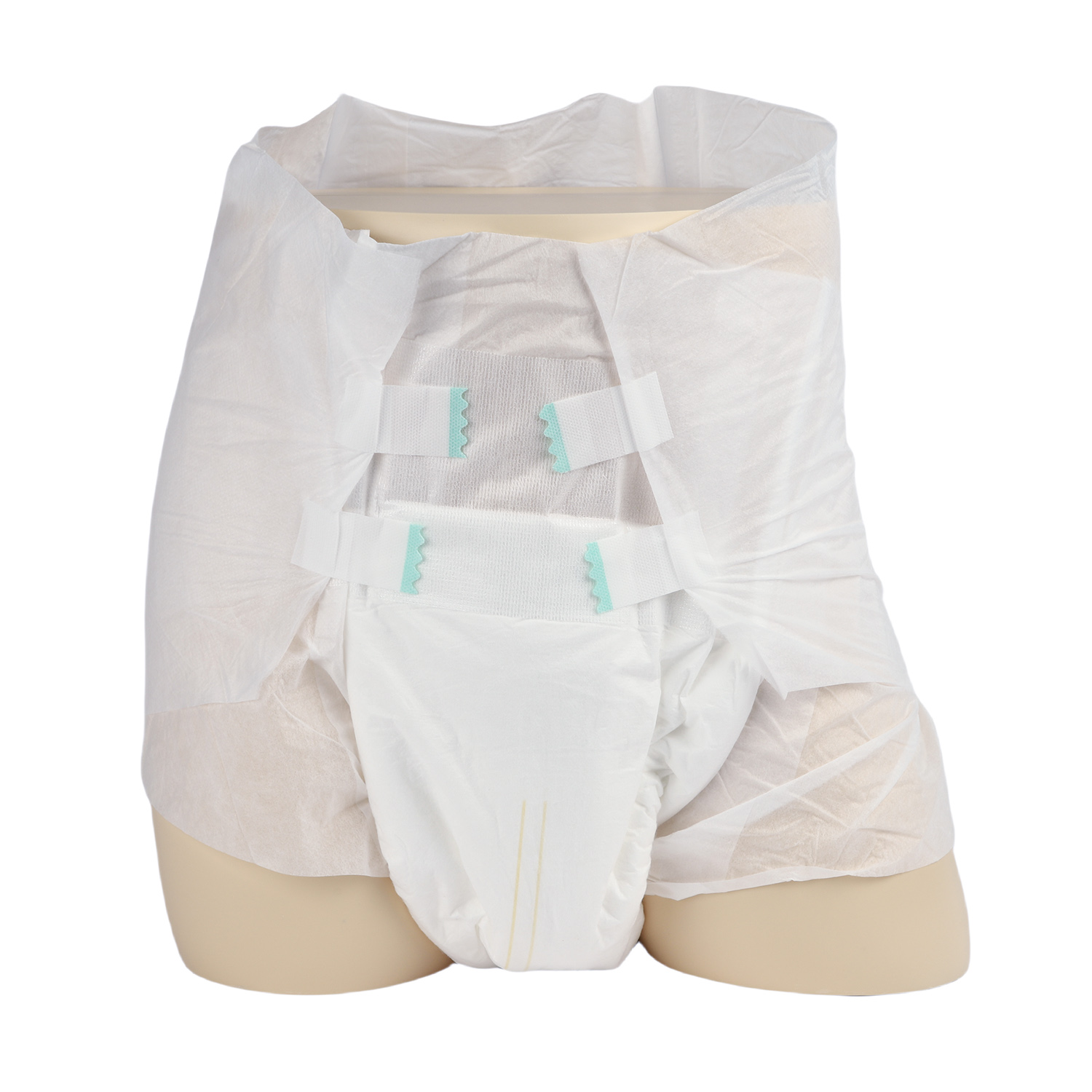
Superabsorbent Polymer (SAP) cores define modern incontinence technology. SAP consists of cross-linked sodium polyacrylate. This chemical compound converts fluid into a stable, thick gel. This chemical process prevents "press-out" leaks. Press-out occurs when a user sits or lies down on a saturated pad, forcing liquid back to the surface. Inferior products release liquid back onto the skin under pressure. High-quality SAP locks the moisture away permanently. This technology allows high absorption adult diapers to hold massive volumes of fluid while keeping the surface layer completely dry.
You must analyze the balance between maximum bulk absorbency and product stiffness. Older product designs relied heavily on thick wood fluff pulp for capacity. This created rigid, uncomfortable garments that bunched up between the legs. Advanced cores blend SAP with fluff pulp efficiently. They maintain high capacity without excessive rigidity. A flexible core preserves patient dignity. It allows for natural movement, reduces chafing between the thighs, and conforms to the body's natural contours. The fluff pulp acts as a rapid distribution layer, spreading the fluid across the entire length of the pad, while the SAP permanently binds the liquid.
Structural leak prevention mechanisms are non-negotiable. Examine the inner leak guards at the leg cuffs. These tall, stand-up barriers consist of hydrophobic non-woven spunbond polypropylene. They must repel water entirely. They contain rapid voids and sudden bowel movements, giving the core time to absorb the liquid. The guards must sit flush against the groin crease. If they gap, leaks will occur immediately, regardless of the core's capacity. Evaluate the front and rear elastic waistbands. Waistbands mitigate blowout risks during nighttime or supine use. They create a physical seal against the lower back and stomach, stopping fluid from traveling upward when the patient lies flat.
Improper sizing is the leading cause of product failure. Even the best leak proof adult diapers will leak if they fit poorly. A diaper that is too large leaves gaps at the legs, allowing fluid to escape instantly. A diaper that is too small limits core coverage, causes skin tears from tight elastics, and restricts blood flow. You must address the critical need for inclusive and bariatric sizing. Ensure your supplier accommodates all body shapes. Extreme sizes require specific structural reinforcements, such as wider side panels and stronger closure tapes, to maintain leak protection under increased physical stress.
Discuss the importance of closure systems when evaluating fit. Refastenable hook-and-loop tabs work best for cloth-like backsheets. They grip the soft material securely. You can adjust them multiple times without tearing the garment, allowing caregivers to check for wetness and reseal the brief. Heavy-duty adhesive tapes are necessary for plastic-backed options. These tapes stick aggressively to the plastic surface. They lock the diaper in place and prevent sagging under heavy fluid weight. A secure closure system guarantees a custom, reliable fit that holds up during patient transfers and repositioning.
Evaluating an adult diaper manufacturer requires strict vetting. You need a reliable partner for everyday care supplies. Define your criteria clearly before signing any contracts. Look at their total production capacity and lead times. Verify their ISO certifications for medical device manufacturing to ensure sanitary production environments. Ensure they offer full size-run availability, including bariatric options. Lot-to-lot consistency is vital. You cannot afford unexpected drops in quality, changes in SAP ratios, or weak adhesive tapes between shipments.
Differentiate between sourcing directly from a manufacturer versus a specialized distributor. Direct manufacturers offer customization options. They provide the lowest unit cost for high-volume orders. You can often specify SAP ratios, backsheet materials, or wetness indicator designs. Specialized distributors offer brand variety. They usually have more flexible minimum order quantities and can mix pallets with other medical supplies like gloves and wipes. Choose the route that matches your storage capacity, daily usage rates, and logistical capabilities.
Calculate the financial advantages of purchasing bulk adult diapers. Look past the initial sticker price. Calculate the cost-per-use versus the cost-per-unit. Premium, high-absorbency products cost more per unit. However, they drastically reduce the number of daily changes. Using three premium diapers a day costs significantly less in labor, laundry, and waste disposal than using eight cheap ones. This metric demonstrates the true return on investment for high-capacity products. Track your monthly spend on barrier creams and bed pads; you will see these numbers drop when you switch to a premium core.
Detail the logistical benefits of wholesale purchasing. Care facilities, nursing homes, and intensive home-care environments consume supplies rapidly. Buying wholesale adult diapers streamlines your logistics. It reduces the frequency of ordering, receiving shipments, and processing invoices. Bulk purchasing ensures you always have the right sizes on hand. It eliminates the stress of last-minute retail runs, which disrupt care schedules and drain petty cash. A steady supply chain allows caregivers to focus entirely on patient health rather than inventory management.
You must also assess the customer support offered by your adult diaper supplier. Do they provide sizing samples for new admissions? Can they expedite shipping during an emergency or sudden spike in census? A strong supplier acts as a partner in your care routine. They help you troubleshoot fit issues, provide in-service training materials for your staff, and recommend product upgrades as patient needs evolve or new technologies hit the market.
Managing Incontinence-Associated Dermatitis (IAD) requires constant vigilance. IAD presents a severe risk in everyday care. Prolonged exposure to trapped moisture breaks down the epidermis. Caustic enzymes in urine and feces accelerate this tissue damage, raising the skin's pH and destroying its natural acid mantle. Skin breakdown leads to painful sores, dangerous infections, and extended facility stays. You cannot rely on absorbent products alone to prevent this. Even the most advanced SAP core cannot reverse existing skin damage or compensate for poor hygiene practices.
Mitigate IAD risks through strict, evidence-based protocols. Pair high-capacity diapers with rigid changing schedules. Do not leave a patient in a soiled garment just because it has not leaked. Implement proper cleansing routines using pH-balanced wipes or foams. Avoid harsh alkaline soaps that strip the skin of natural oils. Apply thick barrier creams containing zinc oxide or dimethicone after every change. These creams create a physical shield between the skin and future voids. Good skin health requires a combination of premium products and diligent, consistent nursing care.
Supply chain disruptions pose another major risk in everyday care. Stockouts of essential, specific-sized medical supplies cause immediate panic on the floor. Running out of bariatric sizes or high-capacity overnight briefs forces emergency actions. Caregivers often resort to retail purchases at massive markups or attempt to double-pad smaller sizes, which ruins the fit and guarantees leaks. Retail products rarely meet clinical absorbency standards. This leads to increased leaks, frustrated staff, and compromised patient dignity.
Mitigate supply risks by establishing recurring wholesale orders. Automate your purchasing process based on historical usage data. Calculate your par levels accurately. Your par level equals your daily usage multiplied by the supplier's lead time, plus your safety stock. Maintain a calculated safety stock of your most critical sizes. Keep at least a two-week reserve in a dry, climate-controlled storage area to prevent the SAP from absorbing ambient humidity. Diversify your supplier relationships. Do not rely entirely on a single distributor. Have a backup source vetted and ready to activate if your primary vendor faces manufacturing delays or shipping bottlenecks.
Training gaps also threaten implementation success. Caregivers must know how to apply these products correctly. Improper application negates all technical features. Train staff to fold the diaper lengthwise before application. This activates the inner leak guards and creates a channel for fluid. Ensure they pull the garment snug into the groin crease to prevent leg gaps. Tape the bottom tabs straight across and angle the top tabs downward to secure the waist. Proper technique maximizes product performance, prevents leaks, and ensures patient comfort during movement.
Audit your current inventory to identify high-failure products causing excessive daily changes and increased laundry volumes.
Order sample packs of premium tab-style briefs to test sizing accuracy and core capacity on your most challenging patients.
Conduct a two-week trial focusing on overnight use to measure reductions in skin irritation and caregiver fatigue.
Establish a recurring delivery schedule with your chosen supplier based on calculated par levels and safety stock requirements.
A: High absorption products contain significantly more Superabsorbent Polymer (SAP). This polymer converts large volumes of liquid into a firm gel. Retail options often rely on cheap fluff pulp, which holds less fluid and releases it under pressure. Premium clinical diapers also feature faster wicking top sheets and taller leak guards to handle rapid, heavy voids without leaking.
A: Yes, plastic-backed diapers generally offer superior leak protection. The solid plastic exterior creates an impermeable barrier that stops micro-leaks and moisture vapor from passing through to clothing. They also maintain their structural shape better when heavily saturated. Cloth-like materials can stretch and sag under extreme fluid weight, potentially compromising the fit.
A: Track the average number of daily changes required for the patient. Multiply that daily average by 30 days. For example, if you change the product four times a day, you need 120 units per month. Always add a 10% to 15% safety buffer to account for illness, sudden bowel movements, or application errors.
A: Buying directly from a manufacturer usually secures the lowest unit cost and offers potential product customization. Manufacturers often require massive minimum order quantities. A medical supply distributor acts as a middleman. They offer multiple brands, mixed pallets, and lower minimum orders, making them better suited for smaller facilities or home care setups.
A: Measure the user's waist and hips accurately with a tape measure. Use the larger of the two numbers to select the size based on the manufacturer's specific sizing chart. Ensure the diaper sits snugly in the groin crease. The inner leak guards must stand up against the skin, and the tabs should fasten securely without overlapping.
A: No. Thickness usually indicates a high ratio of cheap wood fluff pulp, not high absorbency. Modern premium diapers rely on advanced SAP cores. These cores are thinner and more discreet but hold significantly more fluid than thick, bulky pulp. Focus on the SAP content and working capacity rather than the physical thickness of the dry product.


